How to Choose the Right Console Table for Your Living Room
A console table is one of the most quietly useful pieces of furniture you can add to a living room. It anchors a sofa, fills an empty wall, gives you a landing surface for keys and lamps, and pulls a room together in a way few other pieces can. But choosing the right one — the right size, the right height, the right placement — takes a little more thought than most people expect.
This guide walks you through everything that actually matters when buying a console table, so you end up with a piece that fits your space, suits your style, and earns its place for years.
What Is a Console Table, Exactly?
A console table is a long, narrow table designed to sit against a wall or behind a piece of furniture. It's shallower than a standard table — usually 12 to 16 inches deep — which makes it ideal for tight spaces where a full-depth table would feel bulky.
You'll see console tables used in three main spots:
- Behind a sofa, where they double the sofa's visual weight and add a surface for lamps or decor
- Along a hallway or entryway wall, where they catch keys, mail, and small daily items
- Under a wall-mounted TV, where they hold media equipment without committing to a full media console
The narrow profile is what makes console tables so versatile — they add function without crowding a room.
Step 1: Match the Console to the Right Spot
Before you start measuring, decide where the table will live. The same console table will look right in one spot and wrong in another.
Behind a Sofa
This is the most common use, and the rules are simple. The console should be roughly the same height as the back of your sofa — within an inch or two, give or take. If the console is much taller, it dominates the sofa visually. Much shorter, and it disappears.
Width matters too. Aim for a console that's about two-thirds to three-quarters the length of the sofa. A 90-inch sofa pairs well with a 60- to 70-inch console. Going the full length of the sofa often looks bulky; going too short makes the console look lost.
In an Entryway
Entryway consoles are about function first. You want something narrow enough not to block the walkway — usually under 14 inches deep — but long enough to hold a tray for keys, a small lamp, and maybe a vase. A console with a lower shelf or drawers adds storage for things you don't want on display.
Under a Wall-Mounted TV
If you're using a console as a low-profile TV stand, height becomes the priority. Measure from the floor to the bottom edge of your TV, then choose a console roughly 8 to 12 inches shorter, so the TV sits comfortably above. Width should match or slightly exceed the TV's width for visual balance.
Step 2: Get the Size Right
The single biggest mistake people make with console tables is buying the wrong size. Here's how to avoid it.
Standard Console Table Dimensions
Most console tables fall within this range:
- Length: 36 to 60 inches (smaller models go down to 30; larger models reach 72)
- Depth: 12 to 16 inches (anything deeper and you've crossed into sofa table or buffet territory)
- Height: 28 to 34 inches (matched to standard sofa back height)
If you're buying a console for behind a sofa, prioritize the height match. If it's for an entryway, prioritize the length and depth that fits your wall.
How to Measure Your Space
Take three measurements before you shop:
- Available wall length — measure the full wall, then subtract any clearance you want around the console (at least 6 inches on each side keeps it from looking jammed)
- Walkway clearance — if the console is in a high-traffic spot, leave at least 36 inches of walkway in front of it
- Doorway and stairwell clearance — measure your front door, any narrow halls, and stairwell turns to make sure the assembled or boxed table will fit through
A common oversight: people measure their wall but forget to check whether the table will fit through their front door once it arrives.
Step 3: Choose a Style That Works With Your Room
Console tables come in dozens of styles, but most fall into one of four families. Pick the one that matches the rest of your living room — or, if you want the console to be a statement piece, intentionally pick something one step bolder than the rest of the space.
Modern
Clean lines, minimal ornamentation, often with rectangular tops and frame bases. Modern consoles are easy to integrate into most rooms because they don't demand attention. They work especially well in apartments, open-plan spaces, and rooms with a lot of soft textures (linen sofas, woven rugs).
A modern console table with a clean rectangular top and frame base is one of the most versatile choices you can make — it works in nearly any setting.
Mid-Century Modern
Tapered legs, warm wood tones, a sense of lift off the floor. Mid-century consoles bring character without going formal. They pair beautifully with leather chairs, low-profile sofas, and rooms that mix old and new.
If your living room already leans contemporary but feels too cold, a mid-century natural wood console with drawers adds warmth without changing the whole vibe.
Scandinavian
Light wood, soft curves, restrained palette. Scandinavian consoles feel calm and uncluttered — ideal for rooms where you want furniture to recede and let the space breathe. They work well in smaller homes and rooms with white or pale walls.
Farmhouse / Rustic
Heavier wood, visible grain, sometimes with slatted or paneled details. Farmhouse consoles add texture and warmth — best in rooms with neutral palettes, woven materials, and a lived-in feel.
Step 4: Decide What Storage You Actually Need
Console tables come in three storage configurations. Pick based on what you'll actually put on it — not what looks impressive in product photos.
Open base (no shelf, no drawers). Cleanest look. Best when you have other storage nearby and just want a surface. Easiest to keep looking tidy because there's nothing to fill up.
Lower shelf. Adds display space for baskets, books, or decorative objects. Good middle ground — extra capacity without losing the open feel.
Drawers or cabinet doors. Maximum storage, fully concealed. Best for entryways (keys, mail, gloves) or living rooms where you want to hide chargers, remotes, and small clutter. A console with drawers is also harder to make look minimal — every flat surface tends to attract objects.
If you're undecided: people who buy open-base consoles often wish they had a shelf later. People who buy storage consoles rarely wish they had less. When in doubt, choose the one with a lower shelf or drawers.
Step 5: Choose the Right Material
Most console tables are built from one of two main material categories.
Solid wood. Built from natural wood through and through. Heavier, more expensive, develops character with age, and can be sanded and refinished if it gets damaged. Best if you want a piece that lasts decades and you don't mind the higher price point.
Engineered wood with a wood veneer or finish. A wood-based core covered in a thin layer of natural wood or wood-look finish. Lighter, more affordable, less prone to warping in humid environments. The visual difference is minimal in most styles. Best for renters, first homes, or rooms where the console will move occasionally.
Many quality console tables, including those in our collection, combine both: solid wood for legs, frames, and visible surfaces, and engineered wood for non-visible structural components. This gives you the look and feel of solid wood at a more accessible price.
Step 6: Plan What Goes on Top
A console table only looks finished when you style it well. The good news: you don't need to be a designer to get this right. Three rules cover most situations.
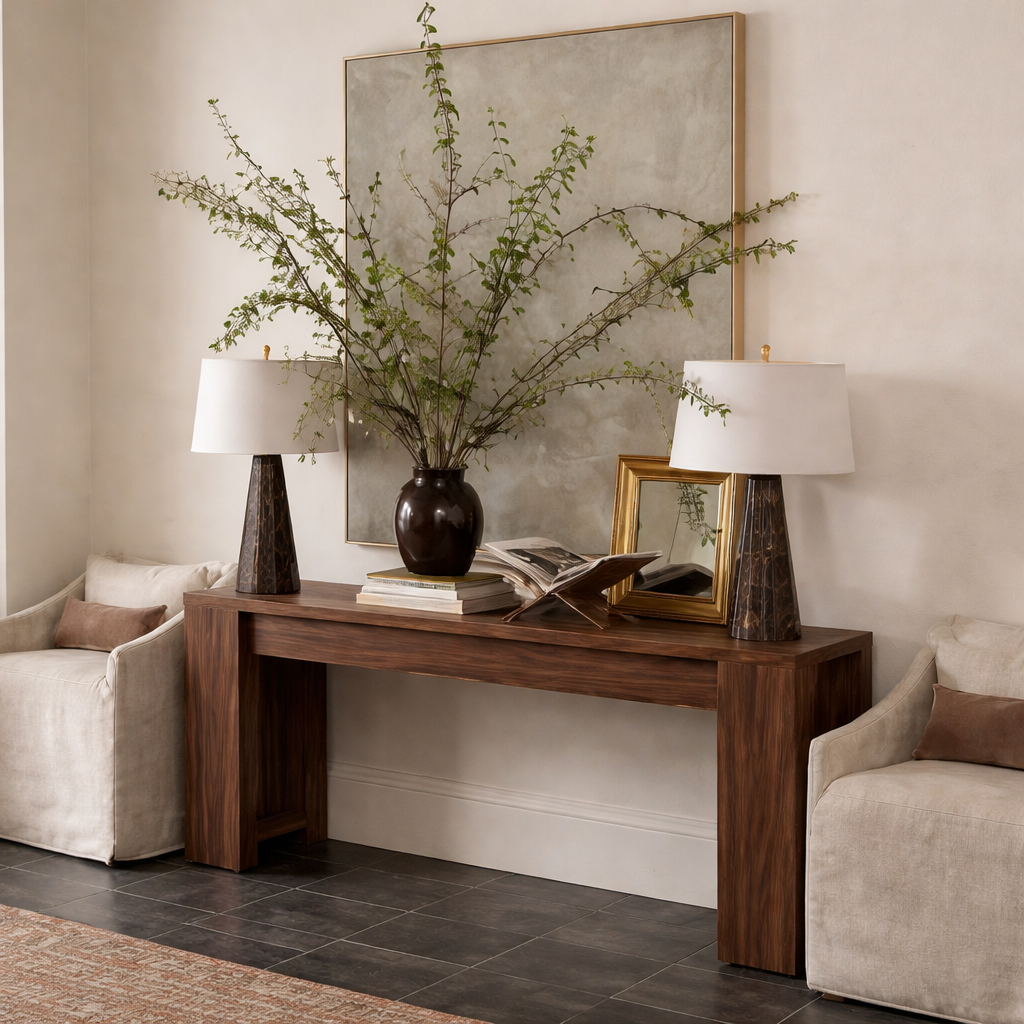
Rule of three. Group items in odd numbers — one large piece (lamp, mirror, large vase), one medium piece (stack of books, smaller vase), one small piece (tray, candle, small object). Odd-numbered groupings feel more natural to the eye than even ones.
Vary the height. Mix tall items (a lamp), medium items (a framed photo), and low items (a tray or coffee table book). A console where everything is the same height looks flat.
Leave breathing room. Cover roughly 60 to 70 percent of the surface. Going fuller looks cluttered; leaving it empty looks unfinished.
A common starting point: lamp on one end, art or mirror centered above, a stack of two or three books with a small object on top at the other end.
Common Mistakes to Avoid
A few errors come up over and over. Skip these:
- Buying too small. A console that's dwarfed by the sofa or wall looks like an afterthought. When in doubt, size up.
- Buying too tall. A console taller than the sofa back creates visual chaos. Match the height within an inch or two.
- Forgetting walkway space. A 16-inch deep console in a 30-inch hallway will get bumped into every day. Leave at least 36 inches of clearance in front.
- Skipping the style match. A glossy modern console in a rustic farmhouse room rarely works. Match the console to the room — or commit to a deliberate contrast.
- Overloading the surface. A console buried under twelve objects loses all its impact. Edit ruthlessly.
A Quick Buying Checklist
Before you click "add to cart," run through this:
- You've measured your wall and have at least 6 inches of clearance on each side
- You've measured the height of your sofa back (if placing behind a sofa)
- You know what you'll store or display on it
- You've checked your front door and hallway for clearance
- The style matches or intentionally complements the rest of the room
- You've decided on solid wood, engineered wood, or a combination
Ready to Find Yours?
A console table is a small commitment that changes how a room feels. Whether you need a clean modern silhouette behind your sofa, a warm mid-century piece for the entryway, or a farmhouse style with storage, the right console will earn its place every day for years.
Browse our full console table collection to see what fits — and what feels right.