

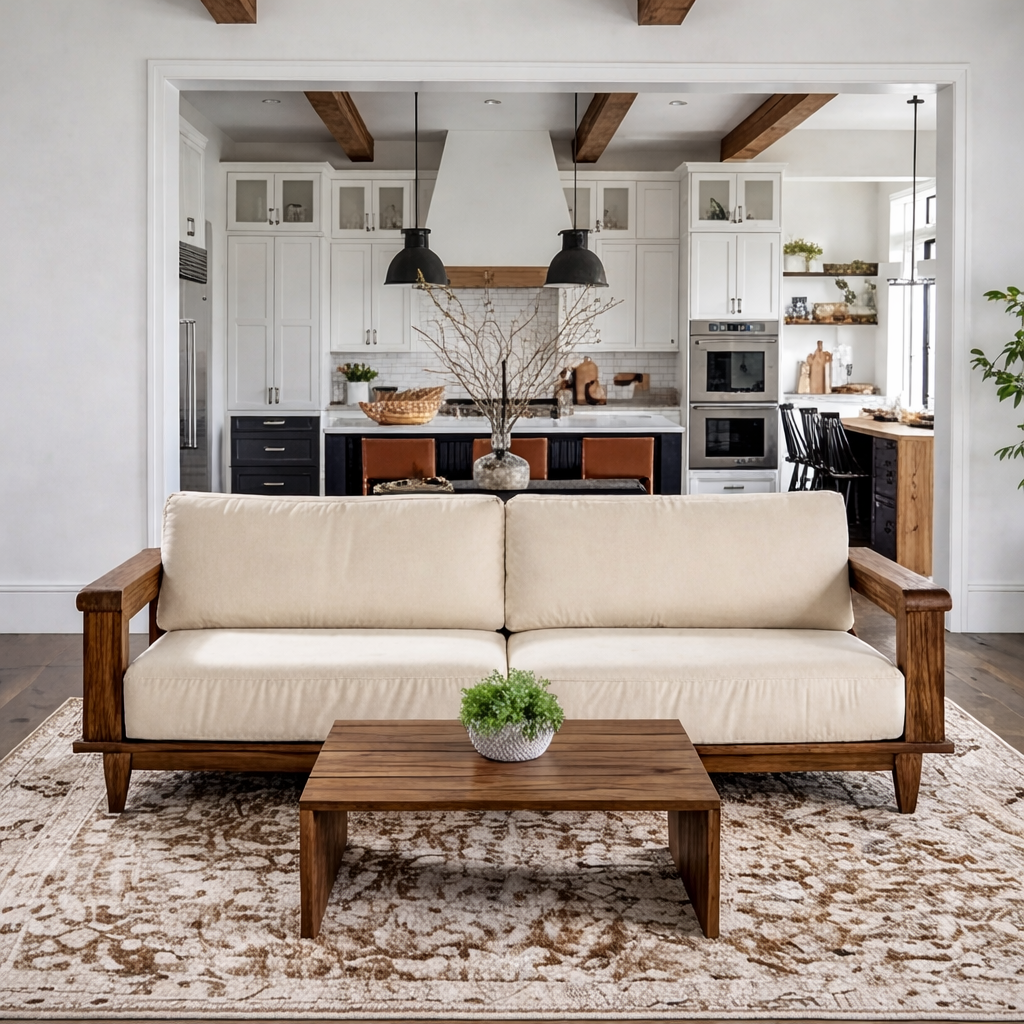
If you've shopped for furniture in the last few years, you've probably seen the same product available in three different price tiers — and noticed the cheapest version is described as "engineered wood" or "wood composite" while the most expensive is called "solid wood." It's the single biggest source of confusion in modern furniture buying, and the answer is rarely as simple as "solid wood is better."
This guide explains what each material actually is, where each one performs better, and how to know what you're buying. The goal is to help you make a smart decision based on how you'll actually use the furniture — not based on assumptions about which material sounds better on a label.
What Is Solid Wood, Exactly?
Solid wood furniture is built from natural wood throughout. Every visible part — and most of the structural parts — is cut from a tree, dried, shaped, and assembled. The most common solid woods used in furniture are oak, walnut, maple, ash, birch, pine, and acacia.
What you're paying for with solid wood:
- Longevity. A solid wood piece, well cared for, can last 30 to 50 years or longer.
- Repairability. Scratches, dents, and water marks can be sanded out and refinished. The piece can be restored multiple times over its life.
- Visual depth. Real wood grain has variation — knots, color shifts, character lines. No two pieces are identical.
- Resale value. Quality solid wood furniture holds its value far better than engineered alternatives.
What you're trading away:
- Weight. Solid wood furniture is heavy. A solid oak dresser can weigh 150+ lbs and require two people to move.
- Price. Solid wood costs more — sometimes 2 to 4 times the price of engineered wood for a similar-sized piece.
- Sensitivity to humidity. Solid wood expands and contracts with moisture changes. In very humid or very dry environments, it can warp, crack, or develop gaps over time.
What Is Engineered Wood?
"Engineered wood" is an umbrella term covering several different materials. They're all built from natural wood that's been broken down and re-assembled — but they perform very differently from each other. The three main types you'll encounter:
Plywood
Plywood is made by gluing thin layers of natural wood (called plies or veneers) together with the grain rotated 90 degrees on each layer. This cross-grain construction makes plywood remarkably strong and resistant to warping. High-quality plywood is used in everything from cabinet boxes to fine furniture frames.
Where it shines: Structural strength, dimensional stability, resistance to warping. Good plywood is sometimes more reliable than solid wood for cabinet construction.
Where it falls short: Visible edges show the layered construction (which is why it's usually edge-banded or hidden). Lower-grade plywood can have voids and weak spots.
MDF (Medium-Density Fiberboard)
MDF is made from wood fibers compressed with resin under heat and pressure. It produces a smooth, uniform surface with no grain — ideal for painted furniture or pieces with a printed wood-look finish. MDF is commonly used in shelves, drawer fronts, and panels in moderately-priced furniture.
Where it shines: Smooth finish, consistent quality, takes paint and laminate beautifully, no warping from grain direction.
Where it falls short: Heavy and not as strong as plywood. Damaged easily by water — once moisture gets into MDF, it swells and can't be repaired. Doesn't hold screws as well as solid wood, especially after disassembly and reassembly.
Particleboard
Particleboard is made from larger wood chips (rather than fine fibers) compressed with resin. It's the most affordable engineered wood and the most commonly used in budget furniture and ready-to-assemble pieces.
Where it shines: Low cost, light weight, acceptable for non-load-bearing parts.
Where it falls short: The weakest of the engineered woods. Highly vulnerable to moisture damage. Can't be sanded or refinished. Hardware (screws, dowels) loosens over time, especially with repeated assembly.
How Most Real Furniture Is Actually Built
Here's something most furniture marketing doesn't tell you: almost all furniture above the budget tier is built from a combination of materials, not one or the other. A "solid wood dining table" usually has a solid wood top and legs, but plywood or MDF panels in non-visible structural areas. A "solid oak cabinet" often has solid oak doors and face frames, with plywood interior panels.
This isn't deceptive — it's smart construction. Combining materials gives you:
- The strength and visual quality of solid wood where you see and touch it
- The dimensional stability of plywood for structural panels
- A more affordable price than fully solid wood would cost
- Less weight, making the piece easier to move and ship
When you see a piece described as "solid wood with engineered wood components," that's an honest description of how furniture is actually made. The question worth asking is which parts are solid and which parts are engineered. As a general rule:
- Tops, legs, frames, and visible surfaces should be solid wood for both look and durability
- Cabinet backs, drawer bottoms, interior shelves, and structural panels are fine in plywood
- Drawer fronts and door panels are usually solid wood on quality pieces, MDF on more affordable pieces
Which Should You Choose?
It depends on three factors: how long you plan to keep the piece, how often it'll move, and your budget.
Choose Solid Wood If…
- You want the piece to last 20+ years and potentially be passed down
- You're okay with higher upfront cost in exchange for longevity
- You're not planning to move frequently (solid wood is heavy)
- You value the look of real wood grain and are willing to maintain it
- You're furnishing a long-term home you own, not a temporary apartment
Choose Engineered Wood (or a Combination) If…
- You're furnishing a first apartment, rental, or transitional home
- You move every few years and want lighter, more shippable pieces
- You're working with a tighter budget but still want a clean, polished look
- The piece will be used in a humid environment (basement, bathroom, garage adjacent) where solid wood would be more vulnerable to warping
- You're decorating a kid's room or guest space where ultra-longevity isn't the priority
For most people in most rooms, a combination piece — solid wood where it matters, engineered wood where it doesn't — is the most practical choice. It gets you the look and feel of real wood at a price that doesn't require a second mortgage.
How to Tell What You're Actually Buying
Furniture descriptions can be vague. Here's what to look for and what to ask before you buy:
Read the materials description carefully. "Solid wood" should mean exactly that. "Wood" alone (without "solid") usually means engineered wood with a wood-look finish. "Solid wood and engineered wood components" is the most honest description and increasingly common.
Check the weight. Engineered wood pieces are noticeably lighter than solid wood pieces of the same size. If a "solid wood dresser" is suspiciously light in the specifications, it likely has more engineered components than the description suggests.
Look at the edges. On photos that show edges (drawer fronts, table edges, cabinet sides), look for the telltale layered look of plywood or the smooth, paper-like surface of MDF with edge banding. Real solid wood shows continuous end grain.
Read the warranty. Manufacturers will often warranty solid wood components longer than engineered ones. A 1-year warranty across the entire piece usually means there's no real distinction in confidence between materials.
Check the assembly requirements. Furniture that ships fully assembled is more often solid wood (the materials handle stress better). Heavily flat-packed furniture with many small parts is more often engineered wood.
A Final Honest Note
Neither material is inherently "better." Solid wood is heavier, costs more, lasts longer, and feels more substantial. Engineered wood is lighter, more affordable, often more dimensionally stable, and can be made to look very close to solid wood. The "right" choice depends entirely on what you're using the piece for and how long you expect to keep it.
The furniture industry sometimes treats this as a moral issue — solid wood as virtuous, engineered wood as cheap shortcut. It's not. They're different materials with different strengths, often combined in the same piece for good reason.
What matters is honesty in the description so you know what you're getting. When you're shopping, look for clear material disclosure on every piece. If a description doesn't tell you what the furniture is made of, that's a sign to look more carefully — or to look elsewhere.
Browse our full furniture collection where every piece is described with clear material information — solid wood where it counts, engineered components where they make sense.

